
Where Small Film Teams Can Stretch Their Budgets in 2026: Film Shoot Costs Across Major U.S. Production Markets
August 20, 2026
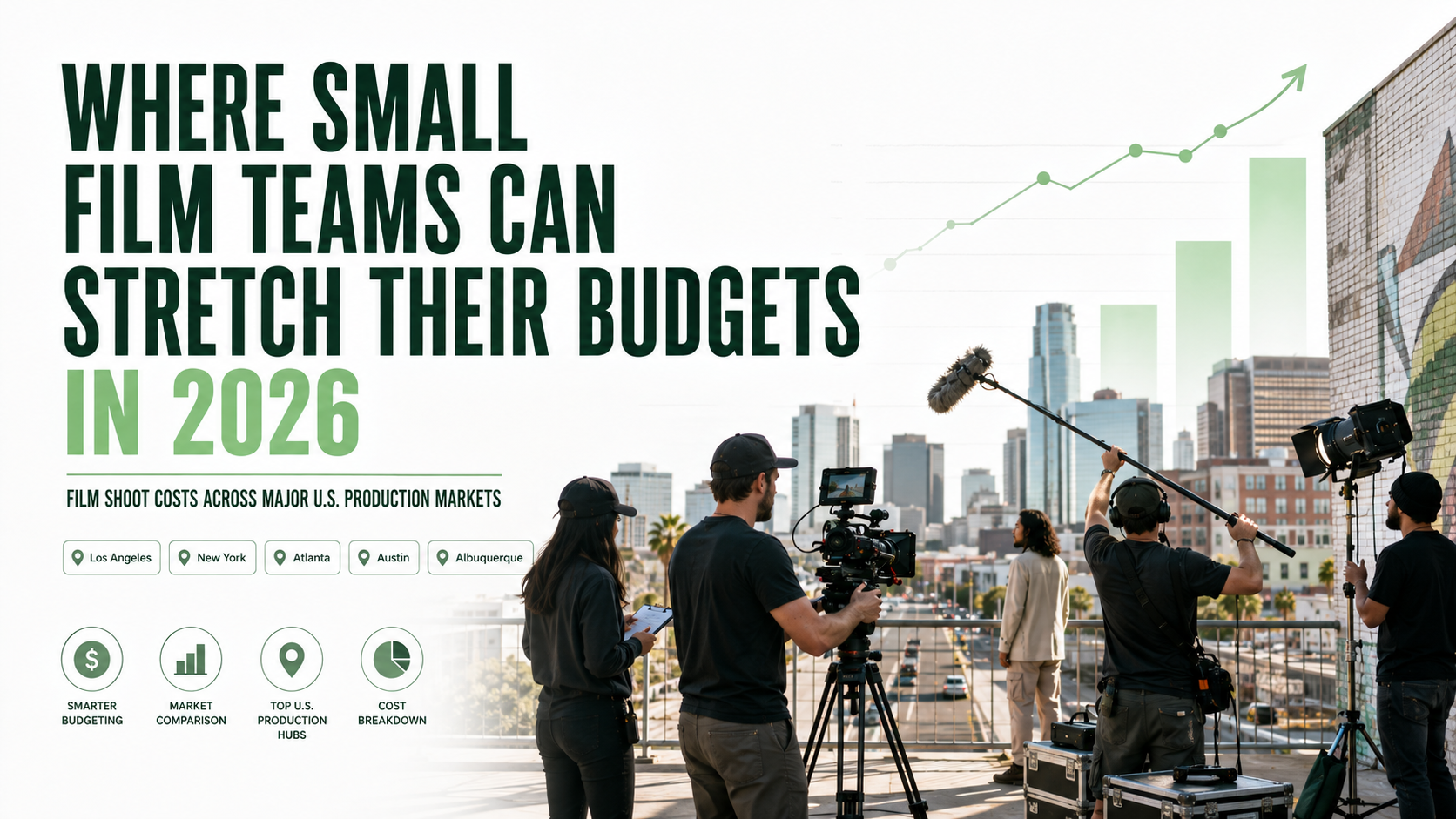
Film production is no longer shaped only by access to major studio infrastructure. As smaller crews, AI-assisted workflows, and lower-cost production tools make high-quality content easier to create, where a project is filmed can have a major impact on how far a budget goes. The breakout success of Obsession shows why this shift matters: the horror film had a reported $1 million production budget and has earned about $460 million worldwide.
At the same time, production costs still vary widely by city. For small crews, the cost of filming can look very different once wages, location rates, permits, and local prices are included.
To see where small productions can stretch their budgets, Giggster analyzed film shoot costs across 40 major U.S. production markets. The report estimates the real cost of a fixed 6-person, 10-hour shoot day and breaks down where crews, filming locations, and standard permit fees are most affordable.
View our full methodology and breakdown here.
Table of Contents
- Where Small Film Production Is Most Affordable
- Where Production Crews Cost the Most and Least
- Where Filming Locations Drive Up Shoot Costs
- American Cities With the Lowest and Highest Film Permit Costs
- Key Terms
Key Takeaways
- The Southwest and West perform well for small-crew shoot affordability, with Santa Fe, NM; Denver, CO; Phoenix, AZ; Salt Lake City, UT; Las Vegas, NV; and Albuquerque, NM, all under $2K per shoot day.
- No single market leads every cost category. Santa Fe, NM, has the lowest overall real shoot cost, at $1.44K per shoot day, while Pittsburgh, PA, has both the lowest crew cost ($1.55K) and the lowest filming location rate ($140/hr).
- The highest-cost markets vary by category: San Francisco, CA, leads for crew costs at $2.98K, while New York, NY, leads for filming locations at $548/hr.
- The average standard permit fee was about $168, though several cities kept upfront permit costs much lower, including Austin, TX; Denver, CO; Detroit, MI; and San Antonio, TX, with $0 standard permit fees.
Where Small Film Production Is Most Affordable
What the Data Shows:
- Santa Fe, NM, ranks first for small-crew film shoot affordability, with an estimated real shoot cost of $1.44K per shoot day, driven by lower crew, location, standard permit, and local price-adjusted costs.
- Boston, MA, is the most expensive market in the study and the only market where the estimated film shoot cost exceeds $3K, at $3.02K per shoot day.
- Across the 40 U.S. production markets studied, the average real shoot cost was about $2.02K per shoot day. Costs ranged from $1.44K in Santa Fe, NM, to $3.02K in Boston, MA.
Where Production Crews Cost the Most and Least
What the Data Shows:
-
Pittsburgh, PA, has the lowest production crew costs among the 40 major U.S. production markets studied, at $1.55K for a fixed six-person crew on a 10-hour shoot day.
-
Crew costs ranged from $1.55K in Pittsburgh, PA, to $2.98K in San Francisco, CA, for the same fixed six-person, 10-hour shoot day.
-
Across the 40 major U.S. production markets studied, the average cost for a 6-person crew was about $1.99K for a 10-hour shoot day.
Where Filming Locations Drive Up Shoot Costs
What the Data Shows:
- The three lowest-cost filming location markets are Pittsburgh, PA; Tulsa, OK; and Santa Fe, NM, all coming in at $151/hr or less.
- New York, NY, and Boston, MA, are the only markets where a 10-hour filming location booking exceeds $5K, compared with the 40-market average of about $2.74K.
- Higher-cost location markets are concentrated in major coastal and destination cities, with Miami, FL; New Orleans, LA; Washington, DC; San Francisco, CA; Charleston, SC; and Honolulu, HI all above $345/hr.
American Cities With the Lowest and Highest Film Permit Costs
Cities with a $0 standard permit fee: Austin, TX; Denver, CO; Detroit, MI; Las Vegas, NV; Orlando, FL; San Antonio, TX; San Diego, CA; and Wilmington, NC.
What the Data Shows:
-
Standard film permit fees range from $0 to $795, with an average of about $168.
-
Cleveland, OH, and Honolulu, HI, have the lowest standard permit costs, at $20 each.
-
Los Angeles, CA, has the highest published standard film permit cost in the study, at $795, followed by New Orleans, LA; Pittsburgh, PA; and San Francisco, CA, each at $525.
Key Terms
Real Shoot Cost
A standardized estimate of what a fixed 6-person, 10-hour shoot day would cost in each market. It includes crew, one filming location, standard permit costs, and local price adjustments. It is not a custom production quote.
6-Person Crew
The same small production team used for comparison across all markets: producer/director, camera operator/DP, sound mixer, gaffer/grip, editor, and production/AV support.
10-Hour Shoot Day
The fixed shoot length used to compare production costs across markets.
Crew Cost
The estimated cost of hiring the fixed 6-person crew for one 10-hour shoot day in each market.
Filming Location Rate
The average hourly rate for filming activity at bookable production locations in each market.
10-Hour Location Cost
The estimated cost of booking one filming location for 10 hours, based on each market's average filming location rate.
Film Permit Cost
The standard local fee a production may need to pay to film in public or regulated spaces. This does not include added costs that may apply for monitors, police support, road closures, parks, parking, insurance, or other location-specific requirements.
Local Price Adjustment
An adjustment that accounts for differences in local price levels so filming costs can be compared more fairly across markets.
Los Angeles Benchmark
The comparison point used throughout the report because Los Angeles is the main U.S. film production hub. Each market's costs are compared with Los Angeles to show whether it is cheaper or more expensive for real shoot cost, crew cost, filming location cost, and permit cost. Los Angeles is used as a benchmark, not because it is the highest-cost city in every category, but because it is the industry's most recognizable production baseline.
Production Market
A city or metro-level filming area included in the study based on production relevance, local resources, incentive availability, film office support, and usable cost data.
You Might Also Be Interested In
Methodology
This report evaluates film shoot costs across 40 major U.S. production markets. The analysis compares markets across four measures: real shoot cost, production crew cost, filming location cost, and standard film permit cost.
Cities were selected based on film-production relevance rather than population alone, including production activity, local or state film office support, incentive availability, crew and vendor resources, filming-location inventory, and regional production potential.
Production Crew Cost
This category estimates the cost of hiring a fixed 6-person production crew for one 10-hour shoot day.
Data was retrieved from the U.S. Bureau of Labor Statistics, Occupational Employment and Wage Statistics program (2025, the most recent available).
The fixed crew included producer/director, camera operator/DP, sound mixer, gaffer/grip, editor, and production/AV support. Annual median wages were converted into estimated daily rates and combined into one standardized crew cost for each market.
Filming Location Cost
This category measures the cost of booking a filming location for production activity.
Data was retrieved from Giggster marketplace listing data, using average filming activity rates by market. Hourly location rates were converted into a 10-hour booking to match the fixed shoot-day scenario (2026).
Film Permit Cost
This category measures the standard local film permit fee a production may need to pay to film in public or regulated spaces.
Data was retrieved from publicly available city, county, and local film office permit pages, using the most recent available published fee for each market. Source years vary by city (2022-2025).
Cities with a confirmed $0 standard permit fee were included as $0. Cities without a usable published standard permit fee were excluded from the standalone permit-cost ranking.
Permit costs do not include added charges that may apply for monitors, police support, fire support, parking, road closures, parks, insurance, or other location-specific approvals.
Local Price Adjustment
This category adjusts costs for local price differences so markets can be compared more fairly.
Data was retrieved from the U.S. Bureau of Economic Analysis, Regional Price Parities by metropolitan area (2024, the most recent available).
Regional Price Parities compare local price levels with the U.S. average, where 100 equals the national average. These values were used to adjust crew, location, and permit costs into real cost terms.
Real Shoot Cost
Real shoot cost estimates the cost of the same fixed production scenario in each market: a 6-person crew, one 10-hour shoot day, one 10-hour filming location booking, and standard permit costs where available.
The real shoot cost was calculated using weighted real costs:
Real Shoot Cost = 60% crew cost + 30% location cost + 10% permit cost
When a usable standard permit fee was not available, the score was reweighted across crew and location costs only. Lower real shoot costs rank higher.
$10K Shoot Hours
Shoot hours covered by a $10K budget were calculated using the following formula: Shoot hours covered by $10K = ($10,000 ÷ real shoot cost) × 10 hours
Values were rounded for readability.
Ranking Convention
Each category was ranked separately. Lower costs rank higher in affordability rankings. Where multiple cities had the same rounded cost, they were assigned the same rank. The next rank is numbered as if the tied positions were occupied consecutively.
Where data was unavailable for a city in a given category, that city was excluded from the numerical ranking for that category.
Things to Keep in Mind
The results are standardized estimates, not quotes for specific productions. Actual costs may vary based on crew experience, union rules, negotiated rates, shoot complexity, location type, equipment, insurance, overtime, travel, lodging, talent, production design, and city-specific requirements.
State film incentives were used for market context only and were not applied as discounts to the real shoot cost.
Costs are rounded for readability, so percentages and totals may not sum exactly from the displayed values. The analysis is intended to compare relative cost conditions across production markets, not to predict the final budget for a specific project.