
Beyond Hollywood: The States Gaining Film Jobs in 2026
August 3, 2026
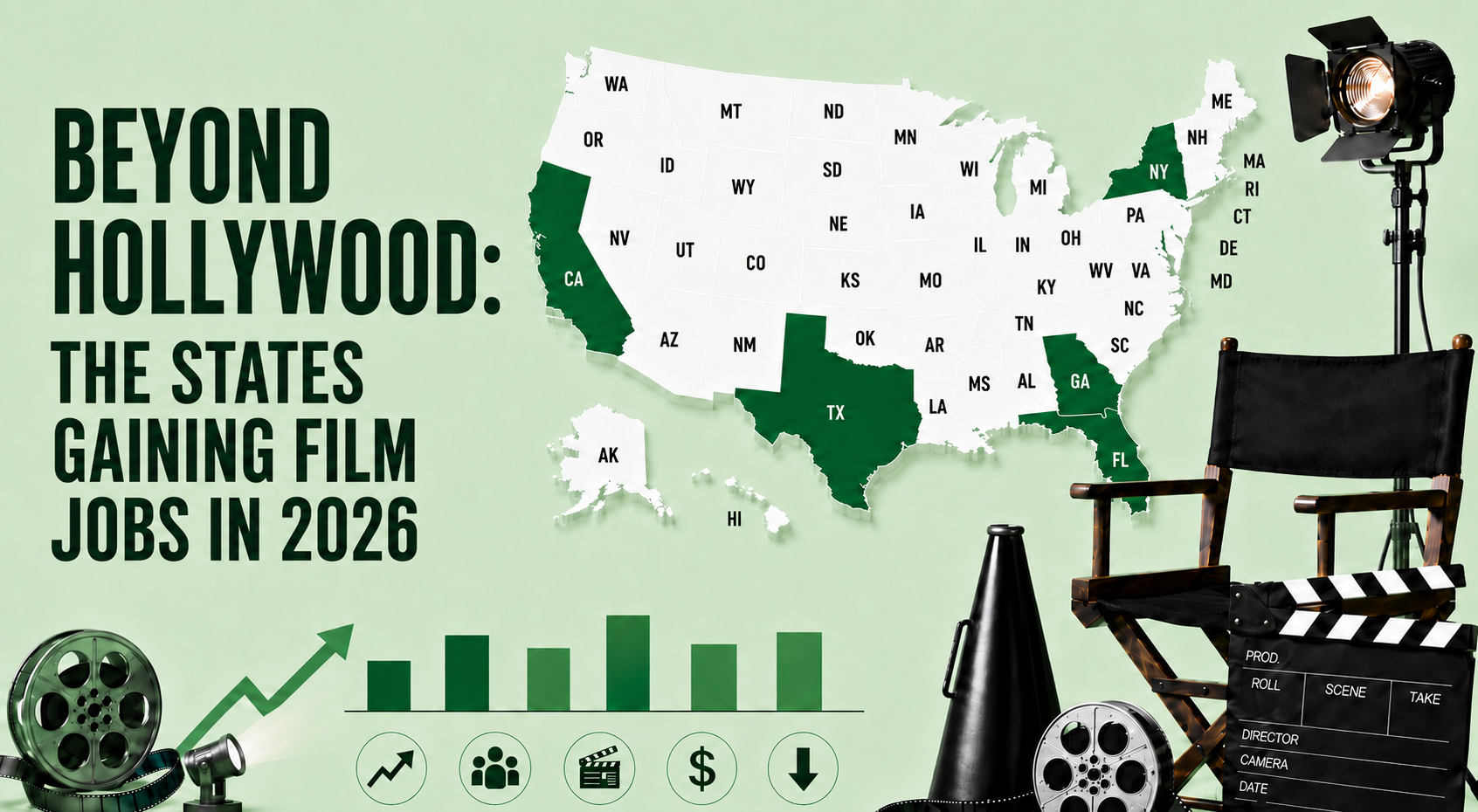
After several years shaped by pandemic disruption, strike-related slowdowns, growing competition among states, and new AI-assisted workflows across development, production, and postproduction, film industry employment has not recovered evenly across the country.
Some states entered 2026 with clear signs of growth in film industry jobs, while others saw steep declines, making employment trends a factor to consider alongside production incentives, costs, and filmmaker support.
To examine these differences, Giggster analyzed average third-quarter motion picture and video industry employment data for all 50 states and Washington, D.C., comparing where film jobs grew fastest, where job losses were largest, which states had the biggest film industry job markets and how employment changed over the longer 2021 to 2025 period.
View our full methodology and breakdown here.
Table of Contents
- Where Film Industry Jobs Grew the Fastest
- Which States Lost The Most Film Jobs?
- The Largest U.S. Film Industry Job Markets
- Fast-Growing Film Job Markets
- Film Industry Employment Trends in Recent Years
- Key Terms
Key Takeaways
-
Rhode Island had the fastest percentage growth in film industry jobs. Average third-quarter employment rose 70.2% between 2024 and 2025.
-
California lost the most film jobs despite remaining the largest market, with employment falling by nearly 13K jobs from 2024 to 2025.
-
California, New York, and Texas remain the largest film job markets, each with more than 20K film industry jobs in 2025.
-
Nevada recorded growth in all four year-over-year comparisons. Average third-quarter film industry employment increased by about 1,500 jobs between 2021 and 2025.
Where Film Industry Jobs Grew the Fastest
What the Data Shows:
-
Rhode Island had the fastest film job growth heading into 2026, with film industry employment rising 70.2% from 2024 to 2025.
-
New Jersey posted the largest job gain among the top 10 growth states, adding nearly 2K film industry jobs while growing 34% year over year.
-
Utah ranked third for percentage growth in film industry jobs. Average third-quarter employment increased 14.2%, a net gain of 806 jobs, between 2024 and 2025.
Which States Lost the Most Film Jobs?
What the Data Shows:
-
California lost by far the most film industry jobs, with employment falling by more than 10% from 2024 to 2025, a decline of nearly 13K jobs, despite remaining the country’s largest film job market.
-
Louisiana had the largest percentage decline among the 10 states in the job-loss ranking. Average third-quarter film industry employment fell about 32%, a net loss of about 1,200 jobs, between 2024 and 2025.
-
Nationwide, film industry employment barely changed from 2024 to 2025, rising by only about 0.7%.
The Largest U.S. Film Industry Job Markets
What the Data Shows:
-
California remained the country’s largest film industry job market in 2025, with 111.4K film jobs, more than any other state nationwide.
-
The three largest film job markets were California, New York, and Texas, each with more than 20K film industry jobs in 2025.
-
Tennessee and Utah ranked ahead of many larger states by film industry employment, with 7.2K and 6.5K jobs in 2025, placing them among the country’s 10 largest film job markets.
Fast-Growing Film Job Markets
What the Data Shows:
-
Utah, Nevada, North Carolina, and Pennsylvania each grew by more than 7% from 2024 to 2025 and had at least 4K film industry jobs in 2025.
-
Rhode Island ranked first for 2025 growth but remained a smaller film job market than other growth leaders, with fewer than 900 film industry jobs.
-
The leading growth markets were spread across the country. The top 10 included jurisdictions in the Northeast, West, Midwest and South.
Film Industry Employment Trends in Recent Years
What the Data Shows:
-
Nevada was the only state in the complete-data comparison to record growth in all four year-over-year periods. Average third-quarter film industry employment rose 54.9% overall between 2021 and 2025.
-
From 2021 to 2025, film industry employment grew in 34 ranked jurisdictions, including Washington, D.C., with gains reaching as high as 54.9%.
-
Major film markets, including California, New York, Georgia, Louisiana, and Hawaii, posted overall declines in film industry employment from 2021 to 2025, with losses reaching nearly 53%.
Key Terms
Unless otherwise noted, annual employment figures in this report refer to average third-quarter employment.
Film Industry Jobs
Covered payroll jobs at businesses classified in the motion picture and video industries, including production, distribution, movie theaters, postproduction and related services. The measure is broader than production-only employment and does not represent all workers in film-related occupations.
Film Industry Job Growth
The percentage increase in film industry employment between two years. The main growth ranking compares 2024 with 2025.
Jobs Added Since 2024
The net increase in film industry jobs from 2024 to 2025. This shows the number of jobs gained alongside each jurisdiction’s percentage growth.
Jobs Lost Since 2024
The net decrease in film industry jobs from 2024 to 2025. This is used to identify jurisdictions with the largest employment losses by job count.
Film Industry Job Market
The size of a jurisdiction’s motion picture and video industry workforce, measured by the number of covered payroll jobs in 2025.
Employment Change, 2021–2025
The percentage change in film industry employment between 2021 and 2025. The comparison includes five annual observations spanning four years.
Year-Over-Year Change
The percentage change in film industry employment from one year to the next.
You Might Also Be Interested In
Methodology
This report evaluates state-level film industry employment changes across all 50 U.S. states and Washington, D.C. The analysis focuses on employment in the motion picture and video industry, comparing recent job growth, job losses, current workforce size, and longer-term employment trends.
Data Source
Employment data was sourced from the U.S. Bureau of Labor Statistics' Quarterly Census of Employment and Wages (QCEW) Employment and Wages Data.
The analysis used:
- Industry: NAICS 5121, Motion Picture and Video Industries
- Geography: All 50 states and Washington, D.C
- Time periods: Q3 2021, Q3 2022, Q3 2023, Q3 2024 and Q3 2025
Employment figures represent average third-quarter employment for each year, calculated from July, August, and September employment counts.
NAICS 5121 includes production, distribution, movie theaters, postproduction and related services. The report uses “film industry jobs” as a simplified label for covered payroll employment in this industry group. The analysis does not isolate production employment or identify which activities account for each jurisdiction’s growth or decline.
Employment Measurement
Employment figures represent average third-quarter employment for each year.
For each jurisdiction and year, employment was calculated as the average of the July, August and September job counts. Using the same quarter keeps the seasonal timing consistent across years. These figures are third-quarter averages, not full-year averages or seasonally adjusted measures.
Job totals were rounded to the nearest whole number in tables and charts. Some chart labels use abbreviated formatting, such as 111.4K, for readability.
2025 Film Industry Job Growth
This category measures where film industry employment grew fastest from 2024 to 2025.
To calculate 2025 job growth:
- 2024 film industry employment was compared with that of 2025;
- The percentage change was calculated for each state;
- States and Washington, D.C., were ranked from highest to lowest based on percentage growth;
- Job counts were included to show the size of each increase;
The “Jobs Added Since 2024” column shows the difference between 2025 film jobs and 2024 film jobs.
Film Industry Job Losses
This category identifies the states that lost the most film industry jobs from 2024 to 2025.
To calculate job losses:
- Average Q3 2024 employment was subtracted from average Q3 2025 employment to calculate net employment change;
- States with declines were ranked from the largest to the smallest absolute decrease;
- Percentage change was included to show the relative size of each decline.
The job-loss ranking is based on the net decrease in average third-quarter payroll employment, not the percentage decline or the total number of layoffs.
Largest Film Industry Job Markets
This category measures the size of each state’s film industry workforce in 2025.
States were ranked based on total film industry employment in 2025. Higher job totals indicate larger motion picture and video industry job markets.
This ranking is separate from job growth. A state can have a large film industry workforce while still losing jobs year over year.
Employment Change, 2021–2025
This category measures changes in long-term film industry employment from 2021 to 2025.
To calculate employment change from Q3 2021 to Q3 2025:
- 2021 film industry employment was compared with that of 2025;
- The percentage change was calculated for each state;
- States and Washington, D.C., were ranked from highest to lowest based on total percentage growth;
- Year-over-year changes were also calculated for 2021–22, 2022–23, 2023–24, and 2024–25.
The table includes only jurisdictions with complete data for all five third-quarter observations.
Ranking
In cases where multiple jurisdictions share the same displayed value, they share the same rank. The next ranks continue in order.
States with suppressed or incomplete data were excluded from rankings where the required values were missing. These states may still appear as N/A in map visuals where applicable.
Things to Keep in Mind
QCEW data counts covered payroll jobs, not unique workers. A person with more than one covered job may be counted more than once. The data does not represent job openings, active hiring listings, or future job availability.
QCEW excludes unincorporated self-employment. Project-based and freelance workers can be included when paid as covered employees. Coverage depends on the employment arrangement, not simply whether someone describes themselves as a freelancer.
The report uses third-quarter employment data for each year to keep the comparison consistent across time. Results may differ from annual-average employment figures or other labor-market datasets. Because some BLS data may be revised after initial release, figures should be understood as the most current available values at the time of analysis.
For more data-driven insights on film, work, and local trends, visit the Giggster Reports page.