
Till Debt Do Us Part: The Real Cost of Getting Married in America in 2026
June 4, 2026
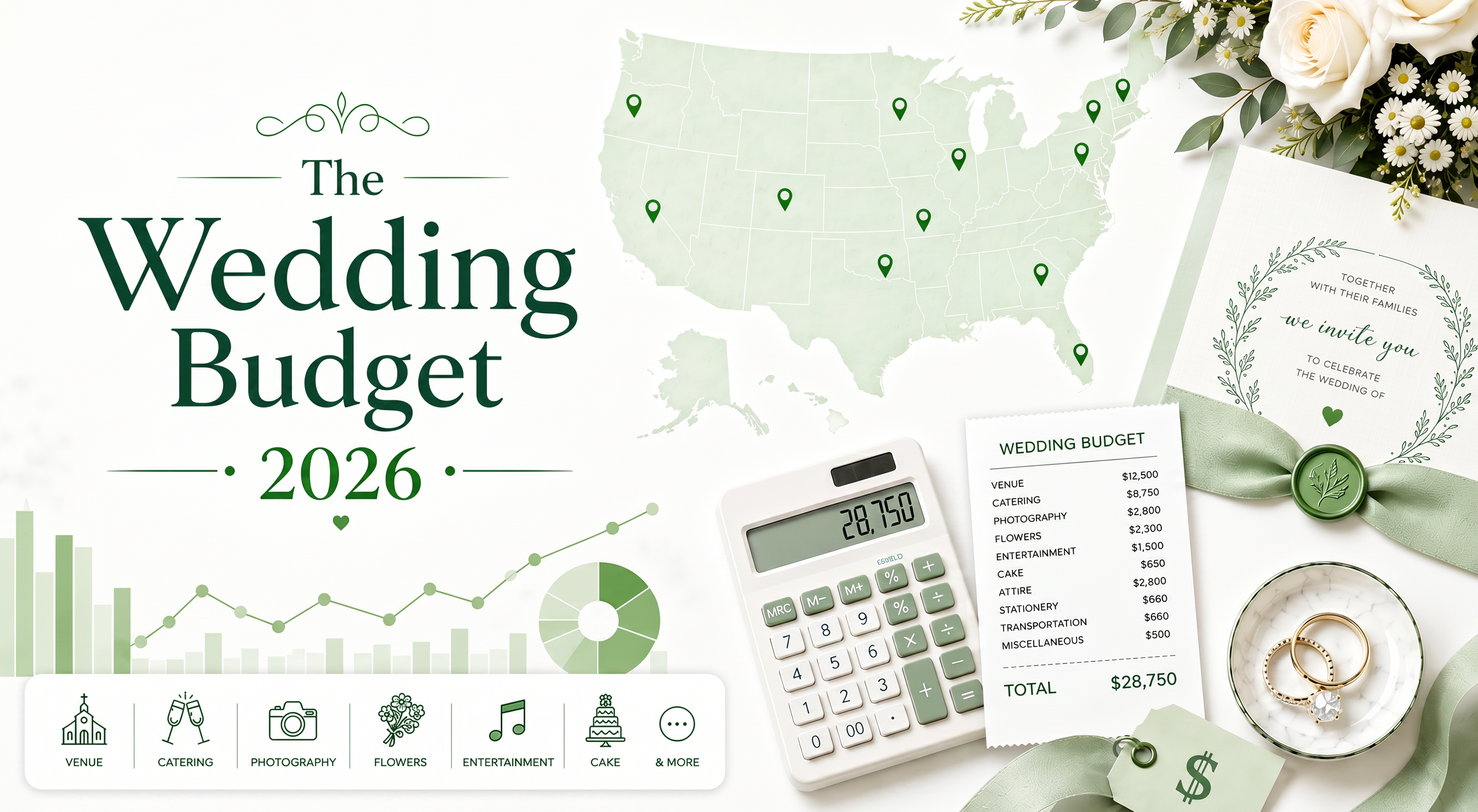
A wedding is a timeless celebration, but the cost of hosting one is far from fixed. In states where more couples are getting married, the price of the celebration can still vary dramatically. A wedding budget that stretches comfortably in one city may feel much tighter in another, especially once reception costs, vendors, catering, and guest expenses are added in.
To identify where weddings are most expensive in 2026, Giggster analyzed 148 cities across all 50 states, focusing on the largest analyzed cities in each state. Using the most recent available data, the report uses 19 wedding-related cost metrics to create a Wedding Cost Index, along with separate benchmarks for estimated reception costs, vendor services costs, and guest weekend costs.
View our full methodology and breakdown here.
Table of Contents
- The Most (and Least) Expensive Places to Get Married in America in 2026
- What Your Wedding Reception Will Actually Cost in 2026
- Places Charging the Most for Wedding Vendors in 2026
- What Guests Actually Pay to Attend a Wedding in Your Market in 2026
Key Takeaways
-
Hawaii ranks as the most expensive state for weddings nationwide; Utah posts the highest reception costs, while Maryland tops the list for vendor services costs.
-
The Northeast is the most expensive region for a wedding, with the highest average costs for receptions, vendor services, and guest weekend expenses.
-
New York, NY, stands out as the priciest wedding city nationwide; Salem, OR, is leading in reception cost, and Indianapolis, IN, is the costliest city for vendor services.
-
Venue and reception expenses are the biggest wedding cost driver, ranking as the main cost driver in 48 of 50 states.
The Most (and Least) Expensive Places to Get Married in America in 2026
What the Data Shows:
-
Hawaii ranks first in the Wedding Cost Index as the most expensive state for weddings, with estimated reception costs of about $4.1K, vendor costs of about $15.1K, and the highest guest weekend cost nationwide at about $122.
-
Arkansas ranks as the most affordable state, with an overall estimated wedding cost about seven times lower than Hawaii, the most expensive state in the country.
-
Across the U.S., average wedding costs are about $4.2K for receptions, $10.5K for vendor services, and $82 for a weekend guest's expenses.
What the Data Shows:
-
New York, NY, Miami, FL, and Urban Honolulu, HI rank as the most expensive major U.S. cities based on the combined costs of receptions, vendor services, and guest expenses.
-
Indianapolis, IN, reports the highest vendor services cost at about $21.2K, while Salem, OR, reports the highest reception cost at about $10.9K.
-
Tulsa, OK, ranks as the most affordable city, followed by Fayetteville, AR; Milwaukee, WI; Chesapeake, VA; and Colorado Springs, CO.*
*These cities are highlighted as the most affordable because they have complete data on reception, vendor services, and guest weekend costs.
What Your Wedding Reception Will Actually Cost in 2026
What the Data Shows:
-
Utah ranks as the most expensive state for wedding receptions, with the highest estimated reception cost at about $10.37K and the highest six-hour venue rental at about $7.26K.
-
Across the U.S., the most expensive wedding reception states exceed $5K, while the most affordable ones range from about $900 to $2.86K.
-
Iowa is the most affordable state for wedding receptions, with estimated venue rental, catering, and bar service costs totaling about $900, roughly 11 times lower than Utah’s nationwide-leading $10.37K.
What the Data Shows:
-
Salem, OR, New York, NY, Salt Lake City, UT, and Providence, RI are the most expensive cities for wedding receptions, each exceeding $10K, about 2.5 times higher than the average of $4.18K.
-
San Antonio, TX, has the highest catering cost nationwide, at about $5.7K, while Aurora, CO, has the highest bar service cost, at about $1.4K.
-
Des Moines, IA, has the lowest wedding reception cost, at about $900, roughly $3.3K below the average.
Places Charging the Most for Wedding Vendors in 2026
What the Data Shows:
-
Maryland ranks as the most expensive state for wedding vendor services nationwide, at about $18.05K.
-
Wyoming is the most affordable state for vendor services, at about $4.48K, roughly four times lower than Maryland and less than half the nationwide average of about $10.4K.
-
The Northeast is the most expensive region for wedding vendors, averaging about $11.8K, while the Midwest is the most affordable, averaging about $9K.
What the Data Shows:
-
Only two cities report wedding vendor services costs above $20K: Indianapolis, IN, at $21.2K, and Baltimore, MD, at $21.0K, which is nearly twice the average of $10.8K.
-
Cheyenne, WY, has the lowest wedding vendor services cost, at about $4.48K, nearly five times lower than the nationwide leader, Indianapolis, IN, at $21.2K.
-
Charlotte, NC, reports the highest design and decor cost at $9.1K, Denver, CO, leads in media and entertainment at $15.6K, while Miami, FL, is the priciest city for beauty services, at $1.8K.
What Guests Actually Pay to Attend a Wedding in Your Market in 2026
What the Data Shows:
-
Hawaii has the highest cost for a wedding guest’s weekend expenses, at about $122, followed by New York ($107) and California ($100).
-
Across the U.S., the average estimated wedding guest weekend cost covering dining, drinks, and local transportation is about $82.
-
Wyoming is the least expensive state for wedding guest weekend expenses, at about $62, nearly half of Hawaii’s nationwide-leading $122.
What the Data Shows:
-
New York, NY, is the most expensive city for wedding guest weekend costs, at about $124, above the reported city average of $81.
-
Miami, FL, has the highest cost of a single casual restaurant meal, at $30, while Charleston, SC, has the highest mid-range dinner-for-two cost, at $150.
-
The South offers both high- and low-cost options for wedding guests, with four cities among the 10 most expensive and seven among the 10 least expensive.
Key Terms
Wedding Cost Index
A 0-100 composite index that compares overall wedding-cost pressure across analyzed cities and states. It combines metrics for venue, reception, vendor, beauty, entertainment, dining, alcohol, and transportation costs. Higher values indicate more expensive wedding markets.
Cost Pressure
A reader-friendly label based on the Wedding Cost Index. Markets are grouped as Extreme, Very High, High, Moderate, or Low depending on how expensive they are relative to the other analyzed cities or states.
Main Cost Driver
The wedding-cost category that contributes the most to a city or state’s overall Wedding Cost Index. For example, a market may be driven mainly by venue and reception costs, vendor services, beauty services, media and entertainment, or guest logistics.
Est. Reception Cost
A dollar benchmark for core reception expenses. It is based on a six-hour venue rental, catering, and bar service costs. It is not standardized to a specific guest count and should not be read as a full reception invoice.
Est. Vendor Services Cost
A dollar benchmark for major non-reception wedding vendors. It includes design and décor services, media and entertainment services, and beauty services, such as florals, rentals, photography, videography, DJ services, wedding bands, hair, and makeup.
You Might Also Be Interested In
Methodology
This report evaluates wedding-cost conditions across 148 analyzed U.S. cities and all 50 states. The city sample focuses on the largest analyzed cities in each state, based primarily on the top three most populous cities per state, where data was available. The analysis compares wedding markets across four major areas: overall wedding-cost pressure, estimated reception costs, estimated vendor services costs, and estimated guest weekend costs.
City Sample
This category defines the cities included in the analysis.
Data was retrieved from the U.S. Census Bureau: City and Town Population Totals: (2020-2025).
The city sample includes 148 analyzed cities across all 50 states. For most states, the sample includes three analyzed cities. Hawaii is based on Urban Honolulu only because additional Hawaii city-level data was not available in the dataset.
Venue and Reception Cost
This category measures core reception-related wedding costs.
Data was compiled from venue pricing data, publicly listed vendor-service prices, and local cost-of-living price data, including Giggster and Numbeo (2026).
Design and Decor Cost
This category measures the cost of the wedding setup and visual presentation.
Data was compiled from venue pricing data, publicly listed vendor-service prices, and local cost-of-living price data (2026).
Media and Entertainment Cost
This category measures the cost of capturing and producing the wedding experience.
Data was compiled from venue pricing data, publicly listed vendor-service prices, and local cost-of-living price data (2026).
Beauty Services Cost
This category measures the cost of wedding preparation and beauty services.
Data was compiled from venue pricing data, publicly listed vendor-service prices, and local cost-of-living price data, including Giggster and Numbeo (2026).
Guest Logistics Cost
This category measures the cost of local transportation around the wedding weekend.
Data was retrieved from Numbeo (2026).
Taxi distance costs were collected per kilometer and converted into an estimated 3-mile taxi ride for the guest weekend benchmark.
Wedding Cost Index
The Wedding Cost Index is a weighted composite index designed to compare overall wedding-cost pressure across the 148 analyzed cities.
The final city index was calculated using the following weights:
Wedding Cost Index Raw:
0.33 × Venue and Reception Cost Score
0.17 × Design/Decor Score
0.22 × Media/Entertainment Score
0.17 × Beauty Score
0.11 × Guest Logistics Score
Each raw cost metric was normalized to a 0-100 scale before being combined into category scores. Higher values indicate higher cost pressure.
Weighting rationale: Venue and reception costs were assigned the highest weight because they represent the largest core wedding-cost category. Media and entertainment, design and decor, and beauty services were weighted as major vendor categories. Guest logistics received a smaller weight because transportation is a supporting wedding-weekend cost rather than a core vendor expense.
Missing Data Adjustment
Missing values were skipped and were not treated as zero. To avoid overstating scores for cities with fewer available inputs, a data-coverage adjustment was applied:
Adjusted City Wedding Cost Index = City Wedding Cost Index Raw × (0.80 + 0.20 × Data Coverage)
Data Coverage = number of available scoring metrics / 19
After the missing-data adjustment was applied, final city index values were rescaled from 0 to 100. The resulting index ranges from 0 to 100, where:
- 0 indicates the lowest relative wedding-cost pressure in the analyzed sample
- 100 indicates the highest relative wedding-cost pressure in the analyzed sample
- Higher values indicate more expensive wedding markets.
Estimated Reception Cost
Estimated Reception Cost is a dollar benchmark designed to show core reception costs in real-world terms.
Estimated Reception Cost = Est. 6-Hour Venue Rental + Catering Cost + Bar Service Cost; Est. 6-Hour Venue Rental = avg. venue price per hour × 6
Catering and bar-service costs reflect average listed vendor-service prices and are not standardized to a specific guest count. Meal-for-two, beer, and wine prices are used as local context in the broader analysis but are not added to this benchmark to avoid double-counting food or bar costs.
Only cities with complete venue, catering, and bar-service data were ranked in this benchmark. Partial rows were marked as unranked or excluded from benchmark rankings.
Estimated Vendor Services Cost
Estimated Vendor Services Cost is a dollar benchmark designed to show major non-reception vendor costs in real-world terms.
Estimated Vendor Services Cost = Design and Decor Cost + Media and Entertainment Cost + Beauty Cost
Design and Decor Cost = Wedding Florist + Event Decor + Party Rentals
Media and Entertainment Cost = Wedding Photographer + Wedding Videographer + Wedding DJ + Wedding Band
Beauty Cost = Hair Stylist + Makeup Artist
Only cities with complete vendor-service data were ranked in this benchmark. Partial rows were marked as unranked or excluded from benchmark rankings.
Estimated Guest Weekend Cost
Estimated Guest Weekend Cost is a dollar benchmark designed to estimate guest-facing wedding weekend costs.
Estimated Guest Weekend Cost = Meal at an Inexpensive Restaurant + 0.5 × Meal for Two + Domestic Draft Beer + 0.25 × Bottle of Wine + Taxi Start + 5 × Taxi 1 km
This represents a sample guest basket: one casual meal, half of a mid-range dinner for two, one beer, a quarter bottle of wine, and an estimated 3.1-mile taxi ride. Only cities with complete guest-cost basket data were ranked in this benchmark. Partial rows were marked as unranked or excluded from benchmark rankings.
Ranking Convention
Where multiple cities or states received the same displayed Wedding Cost Index, they were assigned the same rank. The next rank is numbered consecutively.
Each category is ranked separately.
Dollar benchmark rankings are based on unrounded benchmark values. Dollar amounts may be rounded for display in tables and graphics.
Things to Keep in Mind
The Wedding Cost Index is a comparative index, not a full wedding invoice. It is designed to compare relative wedding-cost pressure across the analyzed cities and states.
Dollar benchmarks are included to provide real-world pricing context, but they should not be read as complete wedding budgets. Reception, vendor, and guest weekend benchmarks combine selected available inputs and do not include every possible wedding expense.
Vendor prices reflect average listed service prices and may differ from final contracted prices. Costs can vary depending on guest count, package type, seasonality, venue policies, negotiation, and local availability.