
Noise Limits by City: Hosting Events Without Breaking the Law in 2026
February 18, 2026
Noise is one of the most common and regulated aspects of hosting events. From private backyard gatherings to large-scale events, cities across the United States impose specific limits on sound levels and operating hours to balance community enjoyment with public order. While these rules are often overlooked during planning, noncompliance can carry real consequences, including fines, permit violations, and even event shutdowns.
For hosts, event planners, and venue operators, understanding local noise regulations is a key part of responsibly reducing event-related risk.
To uncover how event-related noise is regulated across the country, Giggster analyzed municipal noise ordinances across the 30 most populous cities in the United States, compiling a standardized dataset of local sound limits and enforcement practices. View our methodology.
Table of Contents
- Residential Sound Limits for Daytime
- Nighttime Noise Limits: Planning After Dark
- Commercial Noise Regulations and Special Events
- Violation Penalties: Fines for Exceeding Legal Limits
- Key Noise Ordinance Terms
Key Takeaways
- Most daytime residential noise caps at 55–65 dB(A), with California among the most restrictive and Texas among the most permissive, ranging from roughly 50 dB(A) to as high as 75 dB(A).
- Most cities cap nighttime residential noise at 45–55 dB(A), with California cities enforcing the lowest nighttime limits overall, ranging from 40–50 dB(A).
- Only a small group of cities, primarily in Texas and the Southeast, permit daytime commercial noise of up to 85 dB(A), while most major cities, including New York, Los Angeles, Boston, and San Diego, cap levels at 60–70 dB(A).
- Texas stands out as the only state with multiple cities tied for the highest maximum residential noise fine, with Dallas and Houston authorizing penalties of up to $2,000 per violation, more than four times the major-city average of $470.
Residential Sound Limits for Daytime
Across most U.S. cities, residential areas are subject to more restrictive daytime noise limits than commercial or designated entertainment districts. Daytime noise levels in residential zones typically range between 55-65 dB(A), roughly equivalent to normal conversation or low-level background music when measured at the property line.
As a result, even modest sound amplification or increased guest activity can approach regulatory thresholds more quickly than many hosts anticipate.
Activities such as amplified music, announcements, or hosting larger gatherings are still expected to comply with local ordinances. Because most municipalities do not issue noise permits for private residences, compliance largely depends on advanced planning and sound management by the host.
What the Data Shows:
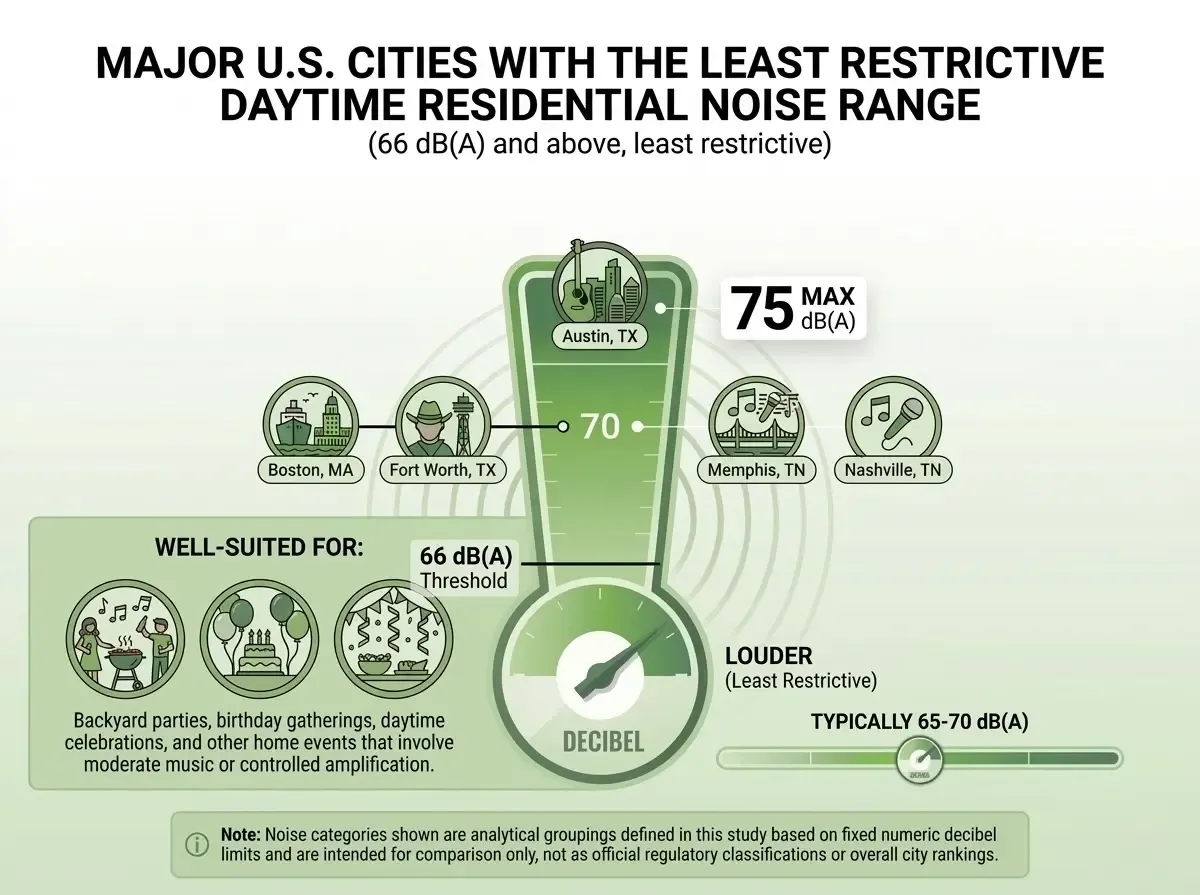
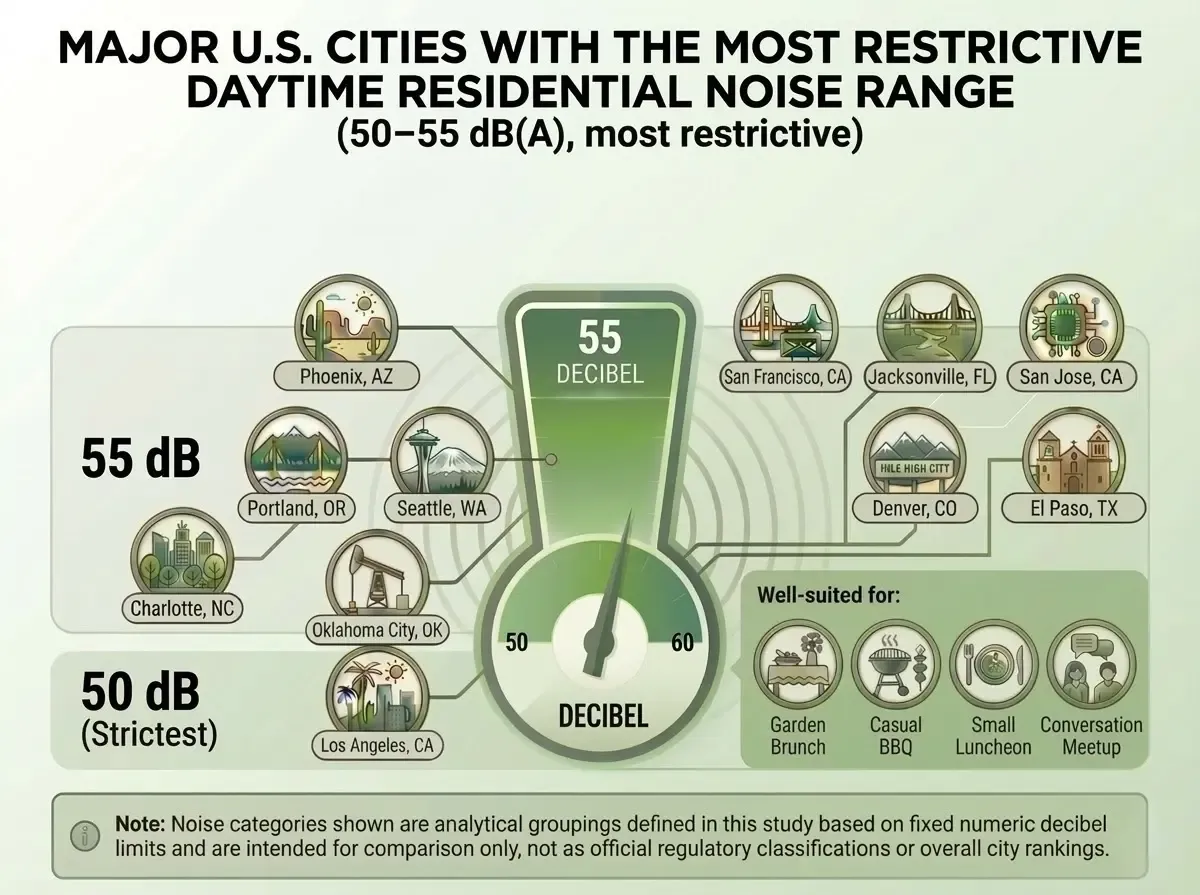
- Cities in the highest daytime residential noise range permit between 70 and 75 dB(A), including Austin (75 dB(A)) and Boston, Fort Worth, Memphis, and Nashville (70 dB(A)). The majority of major cities fall within the 55–65 dB(A) range.
- The gap between the highest and lowest daytime residential limits is 25 dB(A), ranging from 75 dB(A) in Austin to 50 dB(A) in Los Angeles.
- Many major U.S. cities cluster within the mid-range daytime residential limits of 55–65 dB(A), representing the most common regulatory baseline across the dataset.
Nighttime Noise Limits: Planning After Dark
Nighttime noise regulations are significantly stricter across U.S. cities. Based on our analysis of the 30 most populous cities, allowable residential noise levels during designated quiet hours range from 40 dB(A) to 65 dB(A), with most cities clustering between 45 and 55 dB(A). Nighttime hours are most commonly enforced between 10 PM to 7 AM, though exact timeframes vary by jurisdiction.
At these levels, even modest sounds, such as amplified music, elevated voices, or sustained outdoor activity, can exceed legal thresholds more quickly than during the day.
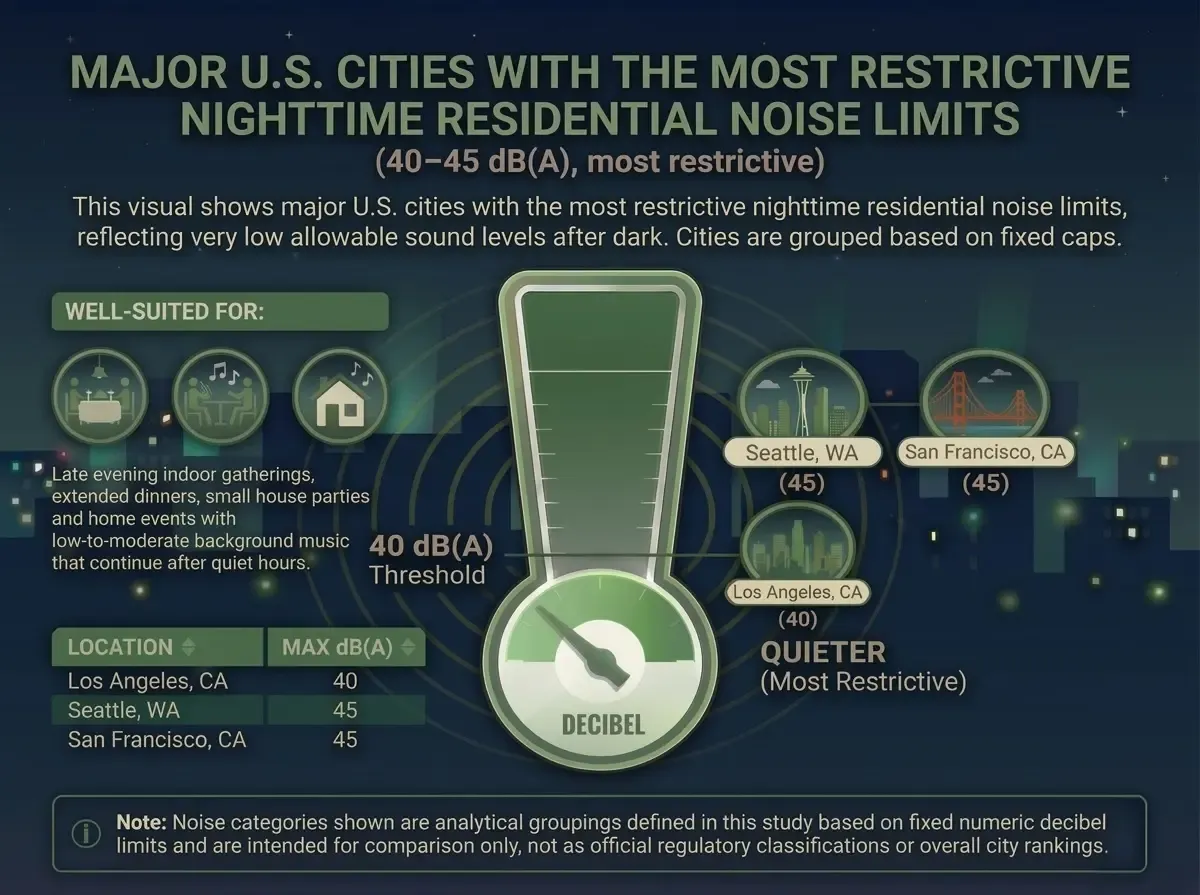
What the Data Shows:
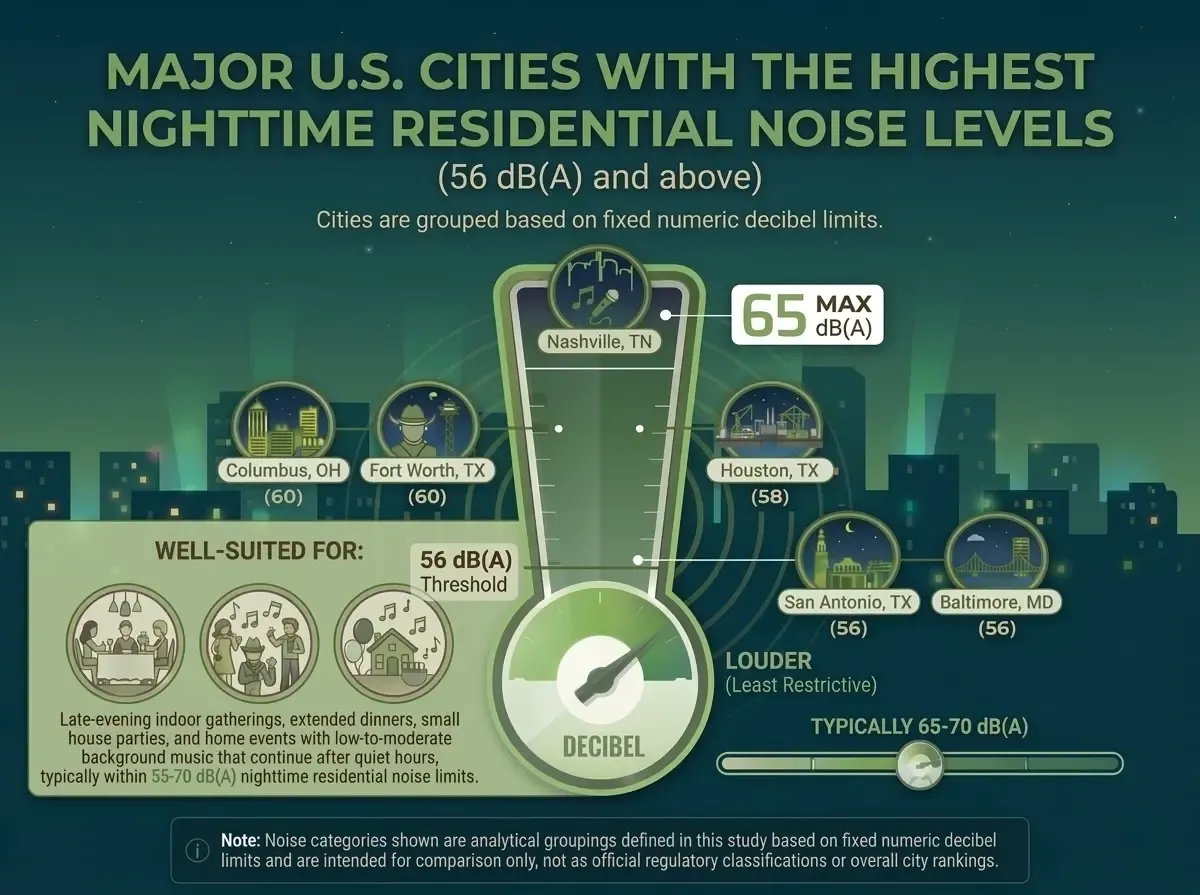
- Nashville permits up to 65 dB(A) at night, followed by Columbus and Fort Worth at 60 dB(A).
- Los Angeles enforces a 40 dB(A) nighttime residential cap, compared with a major-city average of approximately 52 dB(A).
- A large share of major U.S. cities cap nighttime residential noise at around 55 dB(A), reflecting a common enforcement baseline across the dataset.
Commercial Noise Regulations and Special Events
Across the 30 most populous U.S. cities analyzed, where fixed limits are specified, they generally fall between 60-85 dB(A). Most cities cluster in the 65-70 dB(A) range, while a smaller group permits significantly higher thresholds, often 75 dB(A) or more, to accommodate concerts, festivals, and other large-scale public events.
Some municipalities do not set a fixed decibel cap in these zones, instead tying allowable noise to ambient or background sound levels, particularly where commercial areas border residential neighborhoods.
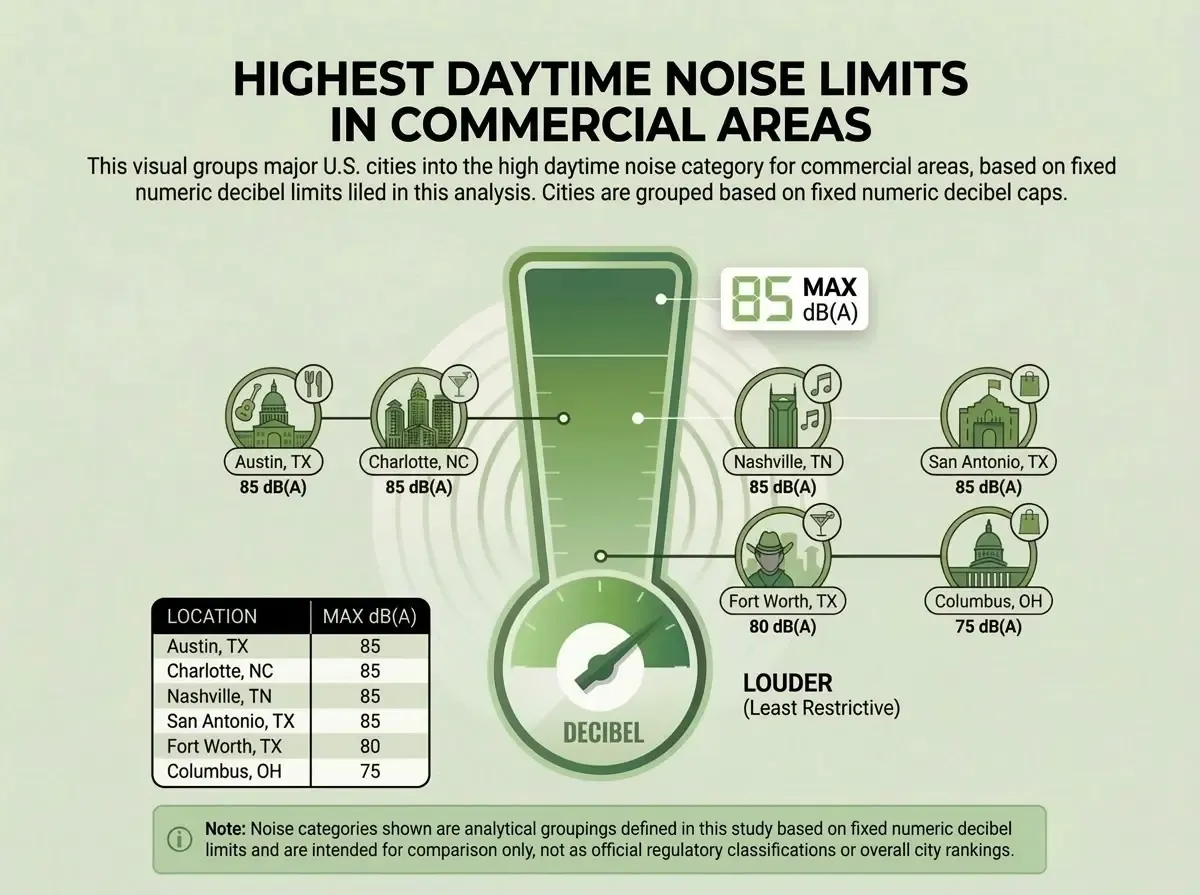
What the Data Shows:
- Austin, Charlotte, Nashville, and San Antonio fall within the highest daytime commercial noise range, allowing up to 85 dB(A).
- Most major cities cap daytime commercial noise between 60 and 70 dB(A), forming the prevailing regulatory baseline outside of the highest-noise category.
- Several major cities, including San Francisco and Philadelphia, regulate daytime noise in commercial or entertainment areas using ambient or background-based standards rather than a fixed decibel limit.
Temporary Exceptions and Special Event Policies
Whether a permit is required depends largely on the scale and characteristics of the event. Many municipalities provide limited exceptions to standard noise regulations through special event permits or temporary variances.
These are most commonly issued for large, one-time public events such as marathons, cultural celebrations, or city-sponsored festivals. In these cases, organizers may be allowed to exceed normal decibel limits during clearly defined time windows and under specific operational conditions, including sound monitoring, crowd management, and advance community notification. For example:
- New Orleans grants parade and special-event permits for Mardi Gras, specifying routes, dates, times, and operational details (such as floats, bands, and vehicles), with police route clearance, before lawfully conducting Mardi Gras parades along designated streets.
- San Francisco offers temporary noise and entertainment permits for select venues and events, but only within pre‑approved hours and under specific limits on amplified sound.
Violation Penalties: Fines for Exceeding Legal Limits
Penalty amounts vary significantly by jurisdiction and are influenced by factors such as zoning designation (residential versus commercial), time of day, and whether the violation is a first or repeat offense. Many cities impose higher fines for unpermitted amplified sound, especially during designated nighttime hours.
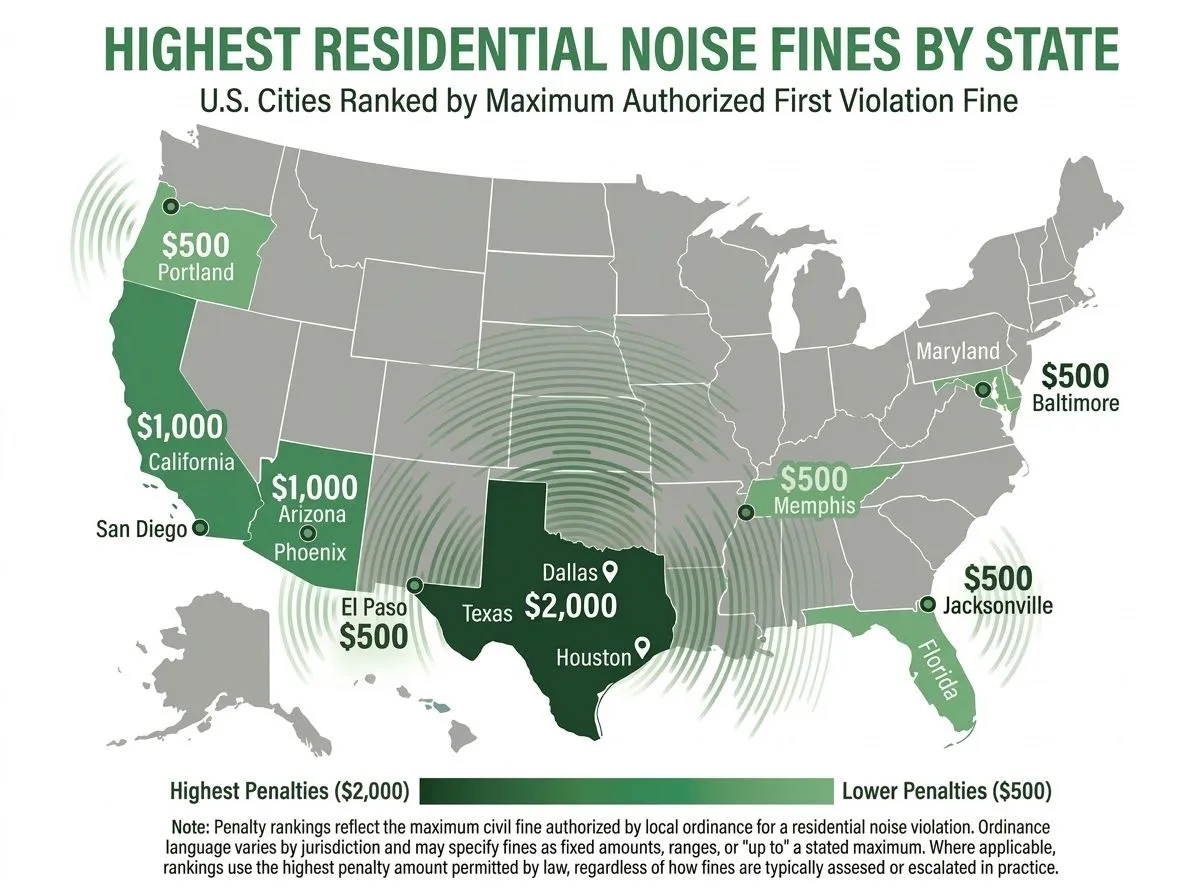
What the Data Shows:
- Noise violations often follow an escalating structure, starting with warnings or minor citations and increasing in severity with repeated offenses.
- Texas stands out for enforcement severity, with Dallas and Houston tied for the highest maximum fine at $2,000, more than four times the major-city average of approximately $470.
- Nevada has the lowest residential noise fine, with Las Vegas starting at $50.
Key Noise Ordinance Terms
Noise Ordinance
A noise ordinance is a local law that regulates how much sound is allowed, where it can occur, and when it is permitted. These rules are set by cities or municipalities to balance everyday activity, events, and commercial operations with the need to limit excessive or disruptive noise.
Decibel (dB(A))
A unit used to measure sound intensity. Most cities use A-weighted decibels, or dB(A), which reflect how the human ear perceives sound.
Residential, Commercial, and Entertainment Zones
Zoning categories that determine which noise limits apply. Residential areas typically have the lowest allowable limits, while commercial or entertainment zones allow higher thresholds.
Nighttime Noise Restrictions
Periods defined by municipal codes during which lower residential noise limits apply, typically overnight. While some cities refer to these periods as “quiet hours,” many enforce nighttime restrictions through reduced allowable decibel thresholds rather than a formally named quiet-hour designation.
Property Line Measurement
A common enforcement method is where sound levels are measured at the boundary of a property rather than at the noise source.
Ambient or Background Noise
The normal sound level of an area without the event or activity in question. Some cities regulate noise relative to ambient levels instead of using fixed decibel caps.
You Might Also Be Interested In
Methodology
For this analysis, Giggster evaluated noise regulations across the 30 most populous cities in the United States, as ranked by World Population Review’s 2026 population data, by reviewing publicly available municipal noise ordinances and enforcement guidelines. Each city was assessed using a standardized set of regulatory and enforcement metrics designed to reflect how noise limits affect event hosts, planners, and venue operators in real-world settings.
The dataset captures residential and commercial noise limits, time-based restrictions, and enforcement frameworks, with values verified against primary government sources where available. For each city, the analysis included:
- Daytime residential noise levels (dB(A));
- Nighttime residential noise levels (dB(A));
- Nighttime, daytime, and quiet hours on working days;
- Daytime noise levels in commercial or entertainment areas, where specified;
- Civil penalties for first-time residential noise violations, including listed fine amounts.
Data comes from municipal websites and legislative records (2024 to 2026).
Scoring and Validation
Each metric in this analysis was assessed independently based on documented regulatory requirements and, where applicable, ordered from highest to lowest or lowest to highest depending on the metric being analyzed. Rankings were determined on a metric-specific basis, including maximum allowable noise thresholds measured in decibels (dB(A)).
Residential and commercial noise limits were also grouped into low and high categories based on fixed numeric decibel ranges derived from the dataset; these category tables present cities by range rather than rank.
For penalty-based rankings, cities were evaluated based on the maximum civil penalty authorized under local ordinance for residential noise violations. Ordinance language varies by jurisdiction: some cities specify fines for a first violation, others apply the same fine structure to each violation, and some define penalties as ranges or “up to” a stated amount. Where applicable, rankings reflect the highest penalty amount permitted by law, regardless of how fines are typically assessed or escalated in practice.
Ranking convention: When multiple cities shared identical regulatory values for a given metric, they were assigned the same rank. Subsequent rankings were numbered as if the tied positions were occupied consecutively.
To ensure accuracy and consistency, the analysis drew on more than 36 data sources, including official municipal websites, city code repositories available through third-party legal code libraries such as Municode Library, American Legal Publishing, and eCode360, and direct correspondence with local government departments.
Noise Level Categories Used in This Analysis
For interpretive clarity, residential noise limits were grouped into low, average, and high categories based on fixed numeric decibel ranges derived from the dataset. These ranges reflect natural clustering in the data and are used for comparative purposes only.
Daytime residential noise limits
- Low (most restrictive): 50–55 dB(A)
- Average: 56–65 dB(A)
- High (least restrictive): 66 dB(A) and above
Nighttime residential noise limits
- Low (most restrictive): 40–45 dB(A)
- Average: 46–55 dB(A)
- High (least restrictive): 56 dB(A) and above
These categories are analytical groupings defined by this study and do not represent legal standards or nationally standardized noise thresholds.
Things to Keep in Mind
While this research reflects the most accurate and comprehensive information available at the time of publication, municipal noise regulations are subject to change. Ordinance updates, enforcement policy revisions, zoning amendments, and local legislative actions can alter permitted sound levels, quiet-hour requirements, and penalty structures with little notice.
Hosts, planners, and venue operators should always confirm current regulations and enforcement practices with local authorities before finalizing event plans.